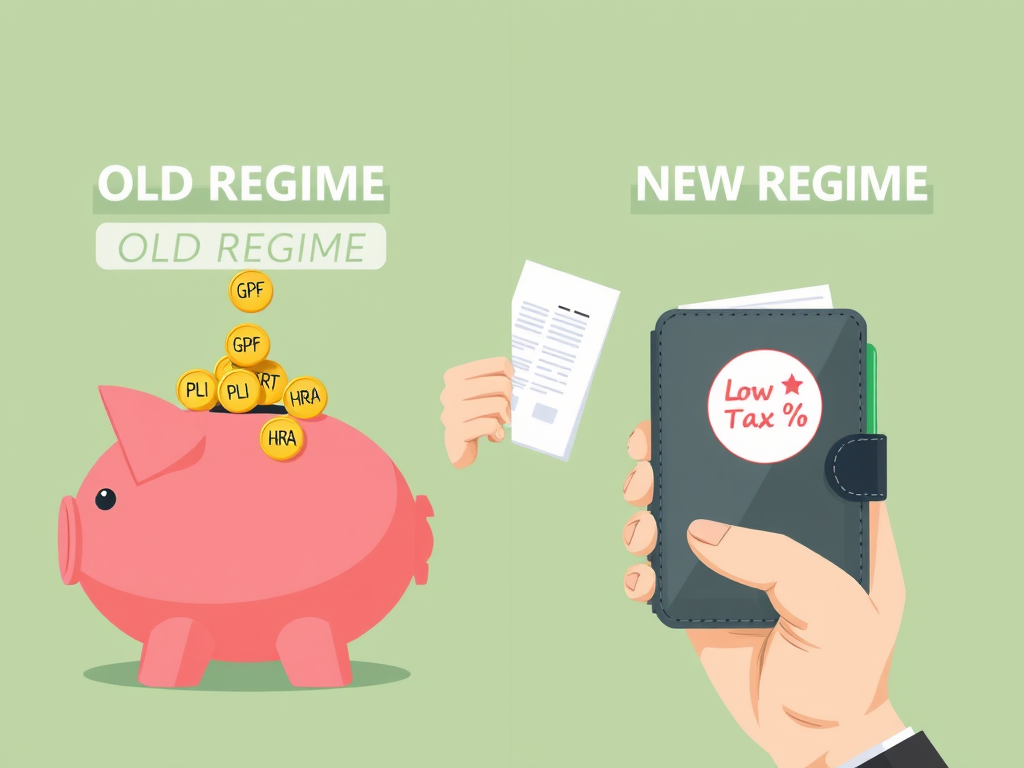
Financial Planning 2026: The rules of the game have changed. With the New Tax Regime becoming the “Default” and offering significantly lower tax rates (and a higher Standard Deduction of ₹75,000), the biggest question for government employees this year is not “Which policy should I buy?” but “Should I even invest for tax saving at all?”
If you stick to the Old Regime, you need to claim at least ₹3.75 Lakhs in deductions to beat the New Regime’s low rates.
In this guide, we list the Best Tax Saving Schemes for 2026, categorized by those available to everyone and those exclusive to Government Employees (like GPF and PLI).
Category 1: The “New Regime” Survivors (Available in BOTH Regimes)
If you switch to the New Tax Regime to enjoy lower rates, most deductions (HRA, 80C) vanish. However, two powerful deductions remain.
1. Employer’s NPS Contribution (Sec 80CCD(2))
- The Benefit: The government contributes 14% of your (Basic + DA) into your NPS account.
- The Rule: This entire amount is Tax-Free and is allowed as a deduction even in the New Tax Regime.
- Strategy: You don’t need to do anything; this is automatic. But ensure it is reflected correctly in your Form 16.
2. Standard Deduction (Hiked to ₹75,000)
- The Benefit: A flat deduction from your gross salary.
- Update: In the 2025 Budget, this was increased from ₹50,000 to ₹75,000.
- Impact: It reduces your taxable income directly, making income up to ₹12.75 Lakhs effectively tax-efficient under the New Regime.
Category 2: The “Old Regime” Champions (Exclusive for Govt Staff)
If you choose the Old Regime, you have access to exclusive instruments that private sector employees often envy.
3. General Provident Fund (GPF) – The Safest Debt Tool
- Eligibility: Old Pension Scheme (OPS) employees only.
- Return: 7.1% (Govt backed, risk-free).
- Tax Benefit: Counts under Section 80C (Limit ₹1.5 Lakh).
- Why it’s best: Unlike PPF (15-year lock-in), GPF is flexible. You can increase your subscription to exhaust your ₹1.5L limit easily without buying unnecessary insurance.
4. Postal Life Insurance (PLI) – High Bonus, Low Premium
- Eligibility: Govt & Semi-Govt employees.
- Return: PLI offers the highest bonus rates in the insurance industry (far better than LIC or private insurers) because of low administrative costs and a healthy mortality pool.
- Tax Benefit: Premiums count under Section 80C.
- Verdict: If you need life insurance, PLI is unbeatable for govt staff.
5. Central Govt Employees Group Insurance Scheme (CGEGIS)
- The Benefit: The small monthly deduction (e.g., ₹30, ₹60, ₹120) from your salary for CGEGIS.
- Tax Benefit: It counts under Section 80C.
- Tip: It’s a small amount, but don’t forget to add it to your total 80C calculation.
Category 3: The “Extra” Deductions (Beyond 80C)
To make the Old Regime work, you need to go beyond the ₹1.5 Lakh limit of 80C.
6. NPS Tier-1 Self Contribution (Sec 80CCD(1B))
- The Booster: You can invest an additional ₹50,000 in NPS Tier-1.
- Impact: This is over and above the ₹1.5 Lakh 80C limit.
- Total Savings: ₹1.5L (80C) + ₹50k (80CCD 1B) = ₹2 Lakhs deduction.
7. Health Insurance (Sec 80D)
- Self & Family: Up to ₹25,000.
- Parents (Senior Citizens): Up to ₹50,000.
- Preventive Checkup: ₹5,000 (within the limit).
- Total Potential: ₹75,000 deduction.
The Verdict: Old vs. New Regime Checklist
| Feature | New Regime (Default) | Old Regime (Optional) |
| Tax Rates | Lower (5% – 15% slabs wider) | Higher (jumps to 20%/30% fast) |
| Standard Deduction | ₹75,000 | ₹50,000 |
| Section 80C (GPF/PLI) | ❌ Not Available | ✅ Available |
| HRA Exemption | ❌ Not Available | ✅ Available |
| Home Loan Interest | ❌ Not Available | ✅ Available (₹2 Lakhs) |
| Breakeven Point | Best if deductions < ₹3.75L | Best if deductions > ₹3.75L |
Conclusion
For 2026, if you are a Govt Employee with a Home Loan + HRA + GPF, the Old Regime likely still saves you more tax.
- Action Plan: Maximize your GPF to fill the ₹1.5L bucket, invest ₹50k in NPS, and ensure you have PLI for protection.